
 GriffNode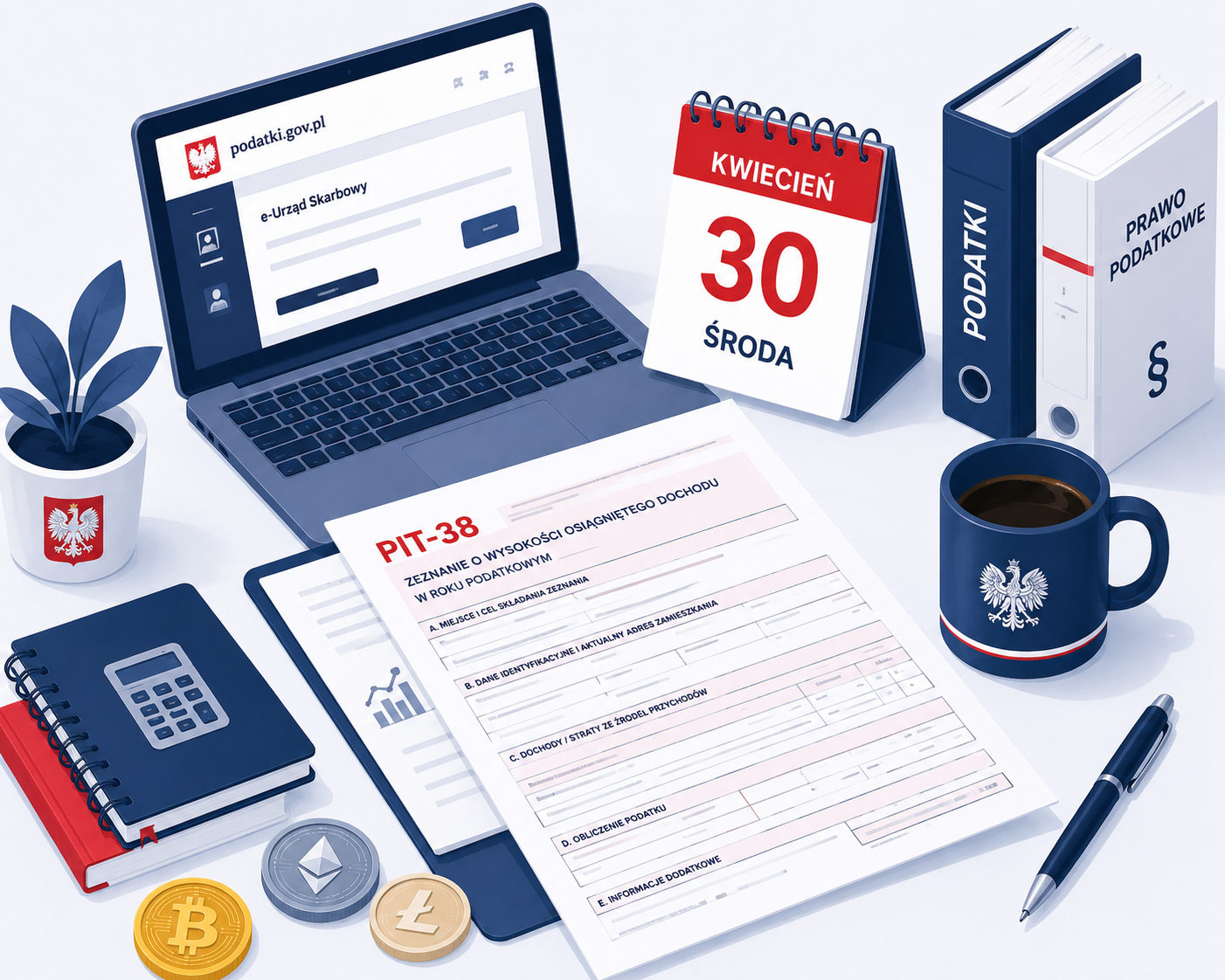
To declare cryptocurrency in Poland you report your crypto gains and losses on the PIT-38 form (Part F, virtual currencies), file it electronically by April 30 of the following year, and pay a flat 19% tax on your net income. You must file even if you only swapped coins or made a loss. This guide walks through every step, from gathering exchange records to submitting and paying.
Overview: What Is the PIT-38 Form?
The PIT-38 is Poland's tax declaration form for capital gains from financial instruments and virtual currencies. If you sold, swapped, or spent cryptocurrency during the calendar year, you are required to file PIT-38 by April 30 of the following year, even if you made a loss.
Specifically, virtual currency income is reported in Part F of PIT-38 (Dochody/straty z odplatnego zbycia walut wirtualnych). This was added to the form after Poland introduced specific virtual currency tax rules in 2019.
If you also have income from dividends, share sales, or derivatives, those go in separate parts of the same PIT-38 form. This guide focuses specifically on the virtual currency section. For the wider legal framework, see our complete guide to Polish crypto tax laws.
Who Has to Declare Crypto in Poland?
You must file PIT-38 if you are a Polish tax resident and you:
- Sold cryptocurrency for PLN, EUR, USD, or any other fiat currency
- Exchanged one cryptocurrency for another
- Used cryptocurrency to pay for goods or services
- Had a net loss from virtual currencies (losses must still be reported to establish carryforward)
If you only bought cryptocurrency and held it without disposing of anything, you have no obligation to file PIT-38 for that activity.
Step 1 - Gather Your Transaction Records
Before you can fill in any forms, you need a complete record of every transaction. Collect data from:
- Polish exchanges (Zonda, BitBay, etc.) - download full transaction history in CSV format. These records are your primary source and will match what the exchange may report to KAS.
- International exchanges (Binance, Coinbase, Kraken, etc.) - download CSV exports for the full tax year (January 1 to December 31).
- Decentralised wallets - use your wallet address on Etherscan, BscScan, or the relevant block explorer to export your transaction history. Tools like Koinly or CoinTracking can automate this.
- Hardware wallets and cold storage - export transaction history via your wallet software (Ledger Live, Trezor Suite).
For each transaction you need: date and time, type (buy/sell/swap/spend), asset name, quantity, and the price in PLN at the time of the transaction.
Step 2 - Convert All Amounts to PLN
All values on PIT-38 must be reported in Polish zloty. If transactions occurred in foreign currencies or in crypto-to-crypto pairs, you must convert to PLN using the exchange rate on the date of the transaction.
The Polish tax administration (KAS) accepts the following rate sources:
- The exchange rate from the platform where the transaction occurred (the actual executed rate)
- The National Bank of Poland (NBP) mid-rate for the transaction date (for EUR/PLN, USD/PLN, etc.)
- For crypto-to-crypto swaps where no PLN rate was involved: the fair market value of the disposed asset in PLN at the time of the transaction, sourced from a reputable exchange or price aggregator (CoinGecko, Binance spot price)
Document your rate source for every transaction. You may need to demonstrate to KAS how you arrived at your PLN values.
Step 3 - Calculate Cost Basis Using FIFO
Poland uses FIFO (First In, First Out) as the standard method for matching which tokens are being sold. This means when you sell Bitcoin, you are assumed to be selling the oldest Bitcoin you hold first.
To apply FIFO correctly, maintain a running ledger of your holdings by purchase date and price:
- List all purchases of each asset in chronological order, with their cost basis (purchase price + fees, in PLN).
- When you make a disposal, match it against the earliest purchases first, consuming them in order.
- The cost basis of the disposed coins is the sum of the purchase prices of the matched lots.
Example: You bought 0.5 BTC for PLN 70,000 in March, then 0.5 BTC for PLN 90,000 in July. In November you sell 0.5 BTC for PLN 110,000. Under FIFO, you are selling the March purchase. Cost basis: PLN 70,000. Gain: PLN 40,000. Tax (19%): PLN 7,600.
Step 4 - Calculate Your Net Income or Loss
Sum all disposals for the year:
- Total proceeds (przychod) - the total PLN value received from all disposals
- Total allowable costs (koszty uzyskania przychodu) - the total cost basis of all disposed coins plus all transaction fees
- Net income or loss = Proceeds - Costs
If costs exceed proceeds, you have a tax loss (strata), which can be carried forward for up to five years but only against future virtual currency income.
Do not mix crypto income with other types of income. The Polish PIT Act requires virtual currency income to be calculated separately and only offset against other virtual currency income. The most common errors are covered in our guide to Polish crypto tax rates, deadlines, and mistakes.
Step 5 - Complete Part F of PIT-38
Log into the e-Urzad Skarbowy portal (etaxes.gov.pl or via the Twoj e-PIT service) or use certified tax software to access the PIT-38 form. Navigate to Part F:
| Row | Field | What to enter |
|---|---|---|
| 36 | Przychod | Total proceeds from all virtual currency disposals (PLN) |
| 37 | Koszty uzyskania przychodu | Total allowable costs (PLN) |
| 38 | Dochod / strata | Auto-calculated as Row 36 minus Row 37 (negative = loss) |
| 39 | Prior-year loss deduction | Carried-forward loss from previous years, if any |
| 40 | Podstawa obliczenia podatku | Taxable base after loss deductions |
| 41 | Podatek (19%) | Auto-calculated: Row 40 x 0.19 |
Row references reflect the current form layout and can shift between tax years, so confirm against the version you are filing.
Step 6 - Verify and Submit
Before submitting:
- Double-check that all amounts are in PLN and rounded to full zloty (no grosze on tax forms).
- Make sure your personal details (PESEL, address) are correct.
- If you have income from other capital sources (dividends, share sales), complete the relevant parts of PIT-38.
- Retain supporting documentation - your exchange CSVs, transaction logs, and rate sources. You do not submit these with PIT-38 but must be able to produce them on request.
Submit via e-Urzad Skarbowy (electronic submission is mandatory for most taxpayers). You will receive confirmation of receipt.
Step 7 - Pay the Tax by April 30
Payment is due by the same date as filing: April 30. You can pay via bank transfer to your local tax office (urzad skarbowy) account. The account number is shown in e-Urzad Skarbowy after submission.
If you cannot pay in full, contact your local tax office before the deadline. It may be possible to arrange an installment plan, but late payment interest will accrue.
How Does Loss Carryforward Work in Practice?
If you had a net loss in the current year, note it on PIT-38 (Row 38 will be negative). You can deduct this loss against virtual currency income in any of the following five tax years. Keep a record of your carryforward amount, as you will need to reference it in future PIT-38 filings. Staking, mining, and DeFi receipts can sit in different income categories - see our DeFi, NFT, and staking tax guide.
Do you have to file PIT-38 if you did not sell any crypto?
If you only bought and held during the year, you had no revenue, so there is no tax to pay. But there is still a reason to file: your acquisition costs.
Under Polish PIT rules, crypto acquisition costs that you cannot deduct in a given year are carried into the next year and increase your deductible costs there. Declaring the crypto you bought, with zero revenue against it, is how those costs get onto the record so they are available to reduce your gain in the year you finally sell. Buy over three quiet years, report nothing, and you can arrive at your first sale with far less cost history than you actually paid.
The same logic applies to a losing year: if you sold at a loss, file anyway. A loss you never declared is a loss you cannot use later.
Rules and interpretations change, so confirm your own position with a Polish tax adviser before relying on any of this.
Declaring Crypto You Earn as a Merchant
If you accept crypto as a business rather than trading it, the income side works differently and is usually business income. A non-custodial gateway helps because every payment lands directly in your own wallet with a clean, exportable record of date, amount, and coin - exactly what you need for accurate PLN conversion at receipt. You can accept crypto payments with GriffNode and keep an auditable trail from day one.
Frequently Asked Questions
How do I declare cryptocurrency in Poland?
Report your total crypto proceeds and allowable costs in Part F of the PIT-38 form, file it electronically through e-Urzad Skarbowy by April 30, and pay 19% on the net gain by the same date. You must file even if you only swapped coins or made a loss.
Do I have to declare crypto if I only traded on foreign exchanges?
Yes. Polish tax residents are taxed on their worldwide income, regardless of where the exchange is based. If you traded on Binance or Coinbase, that income is fully taxable in Poland and reported on PIT-38.
What if I used a DEX and have no records?
Your obligation to report does not depend on receiving a statement. You are responsible for reconstructing your transaction history. Use a blockchain explorer to pull your wallet on-chain history and a crypto tax tool to calculate gains and losses in PLN.
Is there a minimum amount below which I do not need to report?
No. Unlike some countries, Poland has no de minimis threshold for virtual currency income. Even a small gain is technically reportable on PIT-38.
When is the PIT-38 deadline for crypto?
April 30 of the year following the tax year. Both the filing and the payment must be completed by that date. If April 30 falls on a weekend or public holiday, the deadline moves to the next working day.
This guide is for general information only and is not professional tax advice. Polish tax law changes periodically and rules can be updated. Always verify current form requirements at podatki.gov.pl and consult a certified tax advisor (doradca podatkowy) if you have significant or complex crypto activity.
Do I need to file PIT-38 if I only bought crypto?
There is no tax if you did not sell, but filing is still worth it. Polish PIT rules carry unused crypto acquisition costs forward into the following year, so declaring what you bought puts those costs on the record and keeps them available to reduce your gain in the year you eventually sell.
Do I have to report crypto if I made a loss?
Yes, file anyway. A loss you never declared is a loss you cannot set against crypto income in later years. Polish rules allow crypto losses and unused costs to be carried forward, but only if they were reported in the first place.