
 GriffNode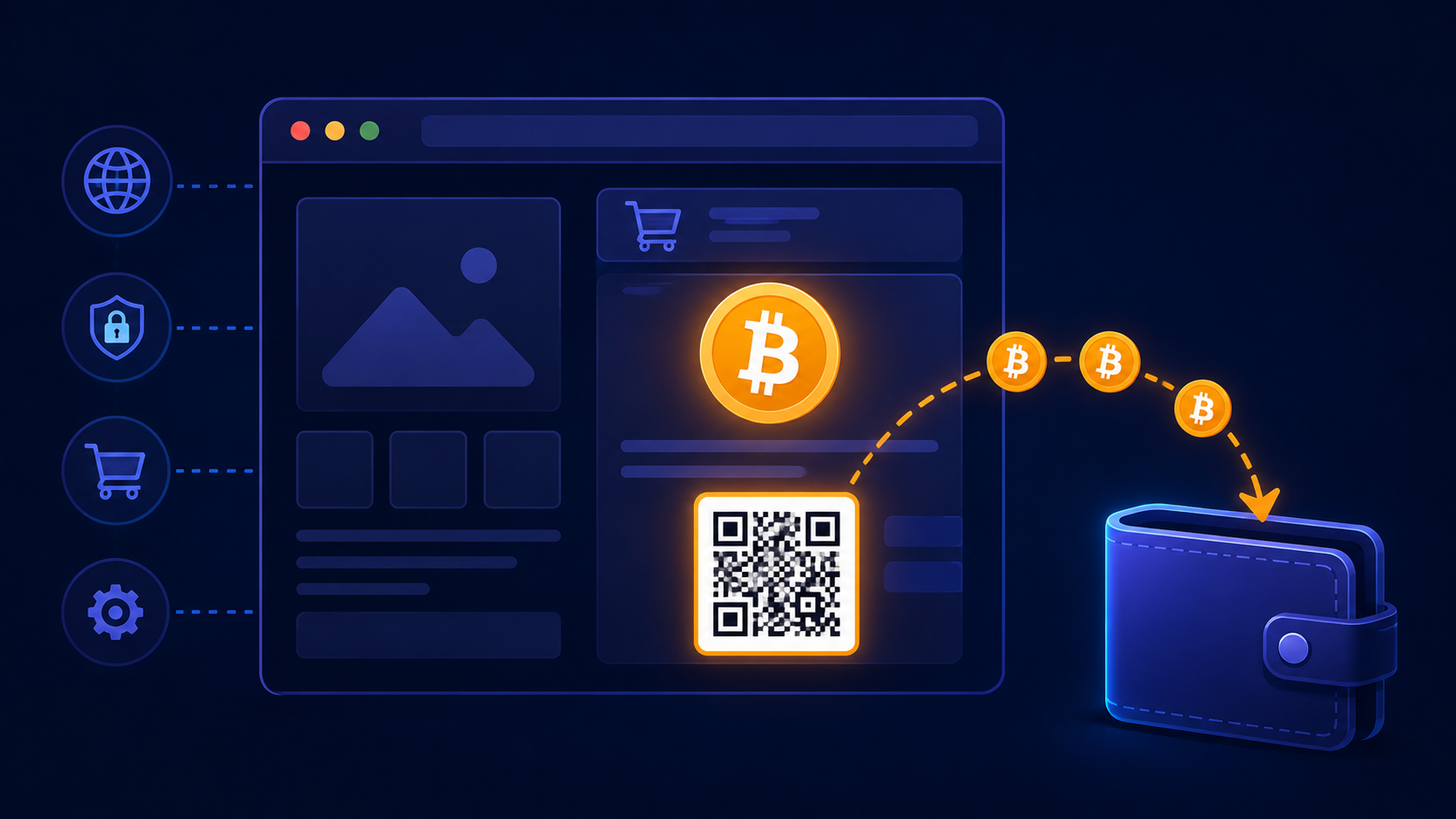
To accept Bitcoin payments as a merchant you need two things: a non-custodial Bitcoin wallet that gives you an xPub, and a payment gateway that generates a unique address per order and watches the blockchain for payment. With a non-custodial gateway like GriffNode the Bitcoin lands straight in your own wallet - no KYC, no chargebacks, and 0% transaction fees. Here is the full setup.
Why accept Bitcoin payments in 2026?
Bitcoin is the world's most recognised cryptocurrency, held by an estimated 100+ million people globally. For merchants, accepting BTC delivers four immediate advantages:
- Zero chargebacks - Bitcoin transactions are cryptographically irreversible once confirmed
- No transaction percentage - with the right gateway, you pay zero per-sale fees
- Instant settlement - funds arrive in your wallet at confirmation, no holding period
- Global reach - any customer with Bitcoin can pay you, regardless of country, bank, or card network
What you need to start accepting Bitcoin
Two things:
- A non-custodial Bitcoin wallet - one that gives you your private keys and an xPub (extended public key)
- A payment gateway - software that generates unique Bitcoin addresses per order and monitors the blockchain for payment
Choosing a Bitcoin wallet for your business
Your merchant wallet should support multiple receiving addresses and provide an xPub key. Do not use a custodial exchange account (Binance, Coinbase) as your business receiving wallet - you do not control the keys, the exchange can freeze your account, and you will not have an xPub.
Recommended options:
- Ledger Nano X - hardware wallet, most secure, xPub available in Ledger Live under Account -> Settings -> Advanced
- Trezor Model T - hardware wallet, open-source firmware, xPub in Trezor Suite under Account -> Public key
- Electrum - free desktop wallet, Bitcoin only, xPub under Wallet -> Information -> Master Public Key
- BlueWallet - free mobile wallet, simple xPub export, good for getting started quickly
How to set up GriffNode to accept Bitcoin
1. Create your account
Sign up at griffnode.com - no KYC required, just an email. You will be prompted to connect your wallet on first login.
2. Connect your wallet via xPub
Paste your xPub key into the wallet configuration screen. GriffNode uses this to derive a fresh, unique Bitcoin address for every transaction - your private keys never leave your wallet, and GriffNode never has access to your funds.
3. Create a transaction for each order
When a customer chooses Bitcoin at checkout, call the GriffNode API to create a transaction:
POST https://api.griffnode.com/v1/transactions
Authorization: Bearer YOUR_API_KEY
Content-Type: application/json

{
  "amount": "149.99",
  "currency": "USD",
  "crypto": "BTC",
  "metadata": { "order_id": "ORD-8821" }
}
The API returns:
payment_address- the unique BTC address for this ordercrypto_amount- the exact BTC amount at the current exchange rateexpires_at- the payment window expiry (typically 30-60 minutes)payment_url- a hosted payment page you can redirect the customer to directly
4. Show the customer the payment details
Display the Bitcoin address, the exact BTC amount, and a QR code. Most Bitcoin wallet apps handle QR scanning natively. If you redirect to payment_url, GriffNode's hosted page handles all of this automatically - no frontend work required.
5. Handle confirmation events via webhook
Register a webhook URL in your GriffNode dashboard. GriffNode sends HTTP POST notifications as the payment progresses:
payment.pending- transaction detected in the mempool (not yet confirmed)payment.awaiting_confirmation- first block confirmation receivedpayment.completed- sufficient confirmations, payment is final
Mark the order as paid in your system when you receive payment.completed. Always verify the X-GriffNode-Signature header before processing any webhook.
How long do Bitcoin confirmations take?
Bitcoin mines a new block approximately every 10 minutes. The number of confirmations you require depends on the order value:
- 1 confirmation (~10 min): Acceptable for orders under $100
- 3 confirmations (~30 min): Recommended for $100-$1,000
- 6 confirmations (~60 min): Standard for high-value orders ($1,000+)
For in-person or time-sensitive sales, Litecoin (2.5-minute blocks) or Dash (InstantSend) offer faster finality than Bitcoin.
What are the fees to accept Bitcoin?
How much you pay depends entirely on the gateway model. Here is how the common Bitcoin payment options compare:
| Provider | Per-transaction fee | Custody | KYC |
|---|---|---|---|
| BitPay | ~1% | Custodial / routed | Required |
| Coinbase Commerce | ~1% | Custodial | Required |
| NOWPayments | 0.5-1% | Routed | Varies |
| Card processors | 2.4-2.9% + $0.30 | Held / payout delay | Required |
| GriffNode | 0% (flat monthly) | Your own wallet | None |
GriffNode charges zero per-transaction fees - you pay a flat monthly plan (there is a free tier). Your customers pay a Bitcoin network (miner) fee, typically $1-8 depending on congestion, which goes to miners, not to any gateway.
Do I need KYC to accept Bitcoin?
With GriffNode - no. Because payments go directly from your customer's wallet to yours (GriffNode never holds funds), there is no regulatory classification that triggers KYC requirements. Sign up with an email and your wallet xPub and start accepting Bitcoin the same day.
What if a customer pays the wrong amount?
Partial payments enter a partial status. You can wait for the customer to send the remainder, or handle the shortfall in your order management system. If no payment arrives within the expiry window, the transaction expires automatically - no charge to anyone, and the address is recycled for future use.
Common mistakes to avoid
- Reusing payment addresses: Never give the same address to two different customers. GriffNode handles this automatically - each transaction gets a unique address.
- Accepting payment before confirmation: A transaction in the mempool is not final. Always wait for the
payment.completedwebhook before fulfilling the order. - Ignoring exchange rate expiry: The BTC amount is quoted at a fixed rate for the payment window. If the customer pays after the window expires, you will receive less or more BTC than expected. Use the expiry timer GriffNode provides.
Related guides
Want the bigger picture first? Read how crypto payment gateways work. Selling on a platform? See accept crypto payments on Shopify or accept crypto payments on WooCommerce. Want stable-value payments too? See how to accept USDT payments.
Frequently Asked Questions
How do I accept Bitcoin payments as a merchant?
Get a non-custodial Bitcoin wallet with an xPub, sign up for a payment gateway like GriffNode, connect your xPub, and create a transaction (or redirect to a hosted page) when a customer chooses Bitcoin. The gateway generates a unique address, watches the blockchain, and notifies you when the payment confirms - and the Bitcoin is already in your wallet.
Do I need KYC to accept Bitcoin?
No, not with a non-custodial gateway. Because the funds never pass through GriffNode, there is no custodial obligation that triggers identity verification. You sign up with an email and your wallet xPub.
How many confirmations should I wait for before shipping?
One confirmation (about 10 minutes) is fine for orders under $100, three for $100-$1,000, and six for high-value orders above $1,000. Always wait for the payment.completed webhook before fulfilling.
What does it cost to accept Bitcoin payments?
With GriffNode the per-transaction fee is 0% - you pay a flat monthly plan instead of a percentage of every sale. Custodial gateways like BitPay and Coinbase Commerce typically charge around 1%. Customers separately pay a small Bitcoin network fee to miners.
Can a Bitcoin payment be reversed or charged back?
No. Once a Bitcoin transaction has enough confirmations it is final and cannot be reversed or charged back, which removes the chargeback fraud risk that comes with cards.
What happens if a customer underpays or pays late?
Underpayments are flagged as partial so you can request the rest or handle them manually. If nothing arrives before the payment window expires, the transaction expires automatically with no charge to anyone.
Start accepting Bitcoin today
Create your free GriffNode account, connect your wallet in under 5 minutes, and add Bitcoin checkout to your website. Zero KYC, zero transaction fees, funds go directly to your wallet.